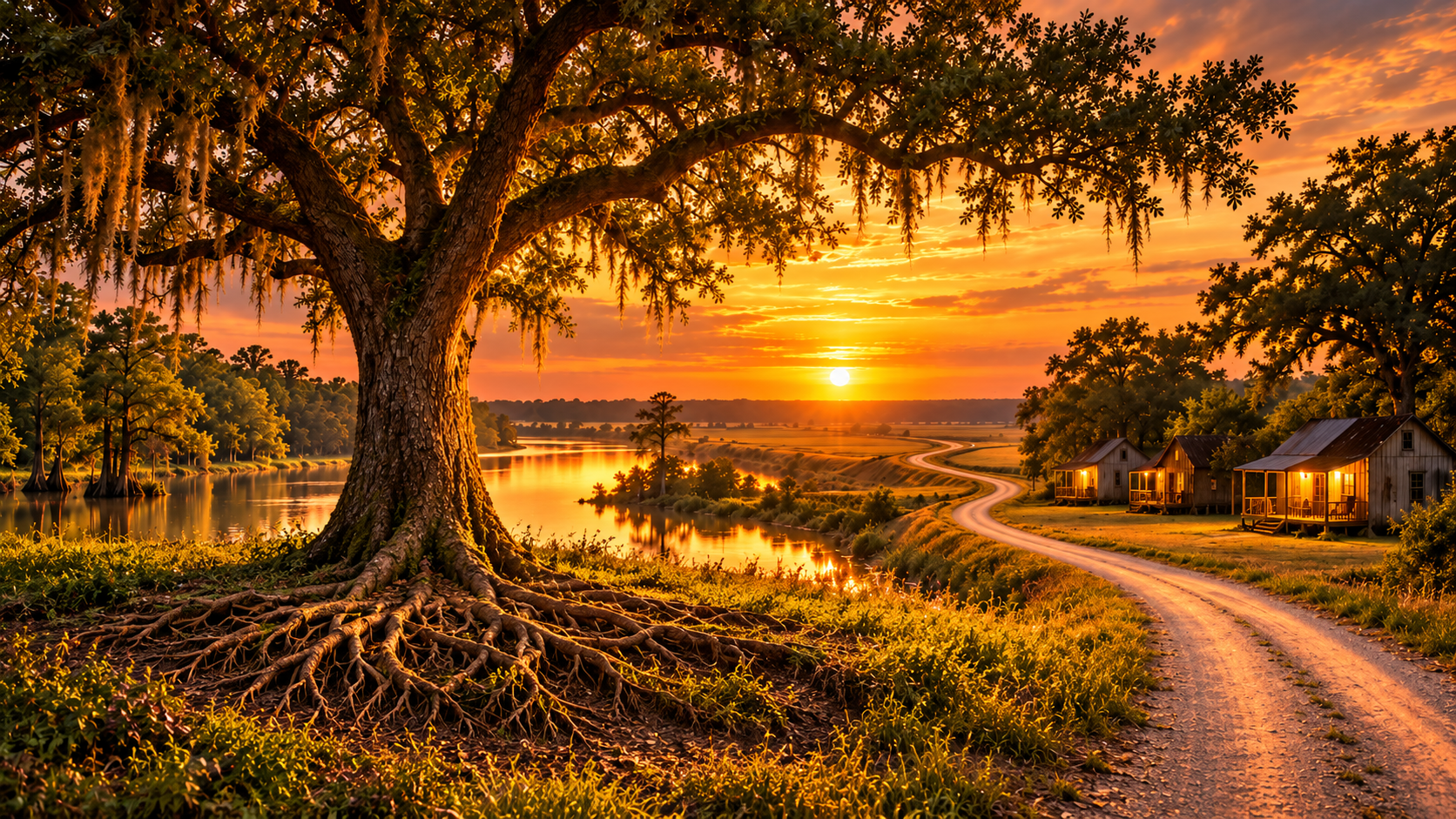
DELTA ROOTS
Roads, Rivers, & Routes
Explore the Soil. Hear the Soul. Discover the Story.
About the Delta
The Delta is more than a place on a map.
It is land shaped by water, communities shaped by movement, and stories carried from one generation to the next.
For centuries, the Mississippi River and the waterways that feed it have carved through this region, leaving behind some of the richest soil in America. That soil grew cotton, rice, soybeans, fruit, vegetables, and livelihoods. It built towns. It drew workers. It created wealth. It also carries the complicated history of the people whose labor made that prosperity possible.
The Delta's story is one of beauty and contradiction.
It is a story of abundance and hardship.
Migration and homecoming.
Faith and struggle.
Loss and resilience.
Work and creativity.
And through it all, the Delta has continued to create.
ROOTS
Long before highways connected these communities, people built lives here along rivers, creeks, fields, rail lines, and dirt roads.
Native peoples lived, traveled, traded, and built societies throughout the Mississippi River Valley for thousands of years before European settlement. Later came settlers, enslaved Africans and their descendants, immigrants, sharecroppers, farmers, merchants, laborers, preachers, teachers, musicians, and entrepreneurs.
Each left something behind.
Recipes.
Songs.
Churches.
Businesses.
Family traditions.
Architecture.
Stories.
The roots of the Delta run deep because generations of people learned how to survive, create, worship, celebrate, mourn, and build community on this soil.
Some stayed.
Some left.
Some came back.
And some carried pieces of the Delta with them wherever they went.
ROADS
The roads of the Delta have always meant more than transportation.
They have carried people toward opportunity and away from hardship.
They connected farms to towns, towns to cities, musicians to juke joints, workers to jobs, families to churches, and communities to one another.
During the Great Migration, millions of Black Southerners left the South for cities such as Chicago, Detroit, St. Louis, Cleveland, and New York. Many carried the sounds, foods, language, traditions, and rhythms of the Delta with them.
The roads out of the Delta helped change America.
But the roads also lead back.
Today, travelers follow them into communities large and small, searching for blues history, civil rights landmarks, family roots, Southern food, river towns, historic churches, festivals, museums, architecture, and the stories of people whose names may never appear in a history book.
Every road has a destination.
But in the Delta, every road also has a story.
RIVERS
The Mississippi River is the great artery of the Delta.
For generations, rivers determined where communities were built, how people traveled, what crops could grow, where commerce developed, and how the region connected to the rest of the country.
They brought opportunity, but they also brought danger.
Floods reshaped communities. Levees changed the landscape. Riverboats carried goods and people. Ports connected small Delta towns to national and international markets.
Along the riverbanks, cultures met.
Music traveled.
Food traditions blended.
Stories moved from town to town.
The river was never simply something people lived beside.
It shaped how they lived.
Even today, the Mississippi remains one of the defining forces of Delta life — a reminder that this region has always been connected to something larger than itself.
ROUTES
Some routes are drawn on maps.
Others are passed down through memory.
The Delta is filled with routes that tell America's story.
Routes traveled by Native peoples.
Routes of slavery and freedom.
Routes followed by sharecroppers and farmworkers.
Routes traveled by civil rights workers.
Routes followed by musicians carrying guitars from one town to another.
Routes that led families north during the Great Migration.
Routes that carried travelers toward new opportunities — and eventually brought descendants back searching for where their families began.
Follow those routes and you begin to understand how deeply the Delta has influenced America.
THE SOIL
The soil is where so much of the Delta story begins.
Rich alluvial earth deposited over centuries by the Mississippi River made the region one of America's great agricultural landscapes.
But the soil holds more than crops.
It holds footprints.
It holds labor.
It holds history.
It holds the memory of generations who worked this land — sometimes freely, sometimes under systems of slavery, exploitation, segregation, and poverty — and still found ways to build families, communities, institutions, businesses, and culture.
The soil produced cotton.
But it also produced stories.
It produced food traditions.
It produced communities.
And from the people who worked it came a sound that would travel around the world.
THE SOUL
If the soil is the foundation of the Delta, the soul is what grew from it.
The Delta gave America some of its most influential music.
Blues emerged from African American communities shaped by work songs, spirituals, field hollers, church music, African musical traditions, and the lived experience of Southern life.
From the blues came new sounds and new possibilities.
Much of American popular music carries some trace of what grew here.
But the soul of the Delta is bigger than music.
You hear it in Sunday morning worship.
You taste it in recipes passed down through families.
You see it in porches, storefronts, fields, churches, murals, juke joints, festivals, and small businesses.
You feel it in the people who know the story of a building that looks ordinary to everyone else.
The Delta's soul lives in memory.
A Region That Changed America
The Delta has played an extraordinary role in American history.
Its agricultural economy helped shape the nation.
Its racial history reflects some of America’s deepest injustices and some of its most important struggles for freedom and civil rights.
Its musicians helped create the soundtrack of the twentieth century.
Its food traditions traveled across the country.
Its churches became centers of faith, organizing, resistance, and community.
Its people carried Delta culture into cities across America and, in doing so, helped transform those places too.
The Delta is not simply a chapter in Southern history.
It is part of the American story.
DELTA ROOTS
DELTA ROOTS was created to help people experience that story.
Not from a distance. Not as a list of attractions. But by following the roads, rivers, routes, people, places, food, music, history, and stories that make the Delta what it is.
We will take you into communities you know — and some you may have never heard of.
We'll introduce you to the restaurant serving a recipe that has been in one family for generations.
The church where history happened.
The road a blues legend once traveled.
The river that built a town.
The business keeping a tradition alive.
The festival bringing thousands of people home.
The person with a story worth hearing.
Because sometimes the places that have shaped America are not marked by giant monuments.
Sometimes they sit beside a two-lane road.
Sometimes they are hidden behind an old storefront.
Sometimes they live in a song.
Sometimes they are carried in the memory of the person sitting across the table from you.
And sometimes you have to slow down long enough to discover them.
DELTA ROOTS invites you to do exactly that.
Follow the roads.
Travel the rivers.
Discover the routes.
Dig into the history.
Meet the people.
Taste the culture.
Hear the music.
And experience the stories that grew from this remarkable soil.
DELTA ROOTS
Roads, Rivers, & Routes
Explore the Soil. Hear the Soul. Discover the Story.
Delta Roots Merch Giveaway
Register below for the DELTA ROOTS merch giveaway, drawn at the end of the 39th Annual King Biscuit Blues Festival. No purchase needed to enter.